
Most people don’t think twice about the clock until they need to work backward from it. Maybe a text message says “this happened 12 hours ago,” or a security clip is timestamped from half a day earlier, and suddenly you’re doing math in your head. It sounds trivial, yet plenty of people pause mid-calculation.
This guide breaks down exactly how to find the time 12 hours ago, why the date sometimes shifts, how AM and PM behave, and where this small calculation actually matters in daily life, from work shifts to travel planning to reviewing old footage. By the end, you’ll be able to solve it instantly, no calculator required.
What Time Was It 12 Hours Ago?
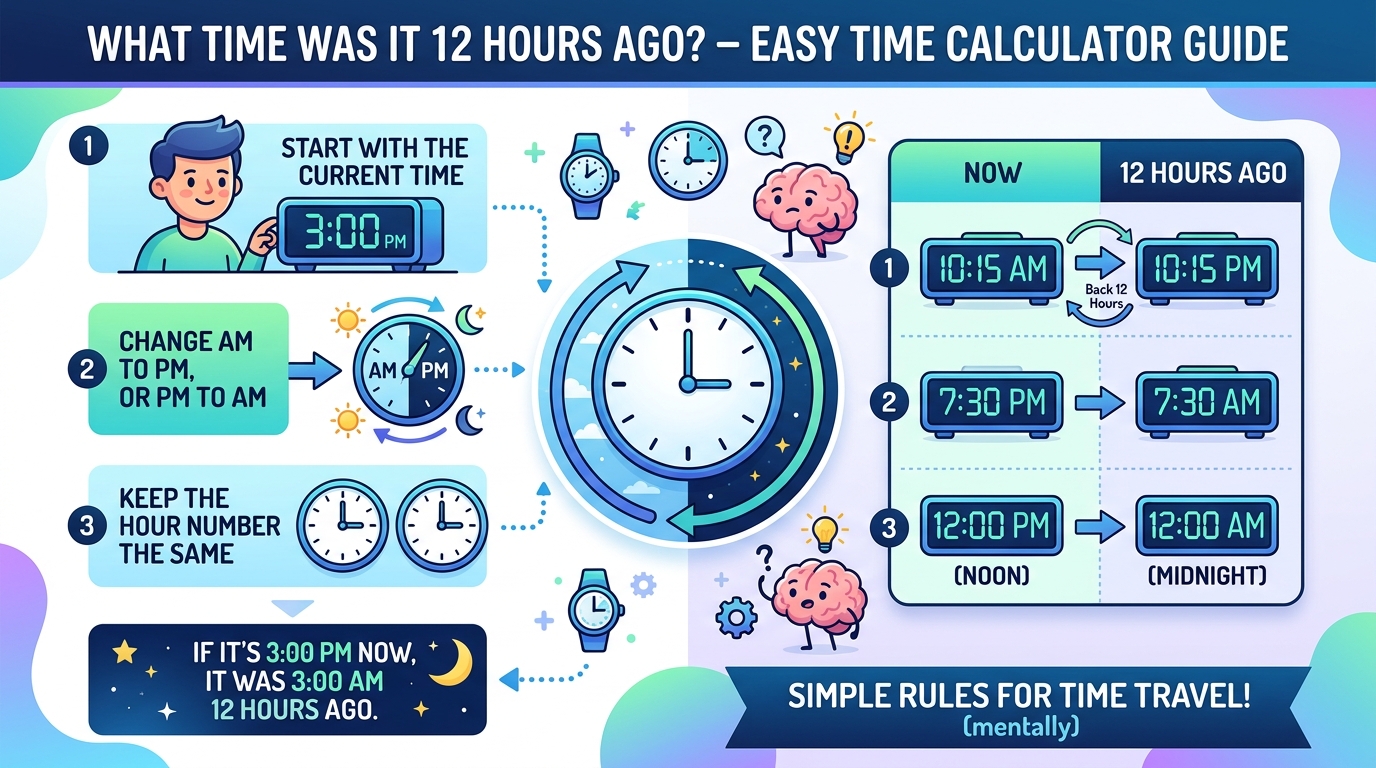
To figure out what time it was 12 hours ago, you simply subtract 12 hours from the current time. Because a full day has 24 hours, moving back 12 hours always lands you on the exact opposite half of the day, morning flips to evening, or evening flips to morning.
Here’s the part that trips people up: the hour and minutes never change. Only the AM/PM label flips, and depending on where you start, the calendar date might roll back to the previous day.
| Current Time | Time 12 Hours Ago |
| 7:20 AM | 7:20 PM (previous day) |
| 7:20 PM | 7:20 AM |
| 2:05 AM | 2:05 PM (previous day) |
| 4:00 PM | 4:00 AM |
| 11:45 PM | 11:45 AM |
| 12:00 AM (Midnight) | 12:00 PM (previous day, Noon) |
| 12:00 PM (Noon) | 12:00 AM (Midnight) |
Once you spot that pattern, the calculation stops feeling like math and starts feeling like a simple flip of a switch.
Understanding the Mathematics Behind Time Calculation
At its core, this is basic subtraction dressed up as a clock problem. Twelve hours can be expressed in a few different but equal ways:
- 12 hours
- 720 minutes
- 43,200 seconds
The formula is short and doesn’t change no matter what time you start from:
Current Time − 12 Hours = Time 12 Hours Ago
Because 12 is exactly half of 24, this subtraction always produces a clean, predictable result, no rounding, no leftover minutes, no guesswork. That’s actually what makes it easier than calculating something like “9 hours ago,” which usually shifts the minute value too.
What Happens When You Cross Midnight?
Midnight is the one moment on the clock that tends to confuse people, mostly because it marks the exact border between two calendar days. When your 12-hour subtraction pushes past that border, the date changes along with the time.
A few quick examples:
- 1:15 AM today → 1:15 PM yesterday
- 12:00 AM (Midnight) → 12:00 PM (Noon) the previous day
- 4:50 AM today → 4:50 PM yesterday
On the other hand, if the current time is already in the afternoon or evening, subtracting 12 hours usually keeps you on the same calendar day:
- 9:10 PM today → 9:10 AM today
The rule of thumb: if your current time falls anywhere between midnight and noon, going back 12 hours will almost always land you in the previous day.
Why AM and PM Switch Every Twelve Hours
The 12-hour clock splits every day into two identical halves, AM (from midnight to just before noon) and PM (from noon to just before midnight). Since each half is exactly 12 hours long, moving back exactly 12 hours always pushes you into the opposite half.
That’s why:
- Morning becomes evening
- Evening becomes morning
- Noon becomes Midnight
- Midnight becomes Noon
It’s a built-in symmetry in how the 12-hour system is structured, and once you notice it, the AM/PM switch becomes automatic rather than something you have to calculate every time.
What Time Was It 12 Hours Ago: Practical Examples
Seeing the rule applied to real numbers makes it stick much faster than reading about it in theory.
Example One
Current time: 8:15 PM Subtract 12 hours: 8:15 AM (same day)
Example Two
Current time: 8:15 AM Subtract 12 hours: 8:15 PM (previous day)
Example Three
Current time: 11:30 PM Subtract 12 hours: 11:30 AM (same day)
Example Four
Current time: 12:00 PM (Noon) Subtract 12 hours: 12:00 AM (Midnight, same day)
Example Five
Current time: 2:40 AM Subtract 12 hours: 2:40 PM (previous day)
Notice that in every single case, only two things ever change: the AM/PM label and, sometimes, the date.
Why People Search “What Was 12 Hours Ago From Now”
This isn’t idle curiosity for most searchers, it’s usually tied to a specific, practical need. People typically want to:
- Check when a message, email, or notification was actually sent
- Review a work shift or timesheet entry
- Trace back a delivery or order timestamp
- Look up security or dashcam footage
- Line up an event with someone in a different time zone
- Verify a bank or app transaction record
- Simply recall what they were doing at that earlier point in the day
In almost every case, the goal is the same: pinning down a past time reference quickly, without pulling out a calendar or doing long division on the clock.
The Role of Time Zones
Time zones add a layer that pure clock math doesn’t account for. If you’re calculating “12 hours ago” purely based on your own local clock, the answer only applies to your location.
For example, someone in Chicago (Central Time) checking a message timestamped 12 hours earlier will get a different real-world reference point than someone in Berlin doing the same subtraction, even if both people are technically “12 hours” behind their own current moment. The confusion usually starts when two people in different regions compare notes without realizing their clocks aren’t aligned.
| Scenario | Consideration |
| Same city, same clock | Simple subtraction works perfectly |
| Different countries, same conversation | Convert to a shared reference like UTC first |
| Scheduling international calls | Always confirm each person’s local time zone |
| Reviewing global event logs | Use UTC timestamps to avoid mismatched dates |
This is why professionals coordinating across regions rely on a shared standard, usually UTC, rather than trusting local 12-hour clocks alone.
Using Online Time Calculators
Manual subtraction works fine for a single quick check, but it gets tedious when you’re dealing with multiple time zones, recurring shifts, or precise timestamps down to the second. That’s where digital tools come in handy:
- Time difference calculators
- Hours-from-now calculators
- World clock converters
- Elapsed time tools
These tools automatically handle date rollovers, daylight saving adjustments, and time zone conversions, the parts of the calculation most likely to trip up a manual estimate. For anything involving international coordination, a calculator is faster and safer than doing it by hand.
Learn more:What Time Was It 15 Hours Ago? – Exact Time Calculator
Human Perception of Time
Mathematically, 12 hours is always exactly 720 minutes, no more, no less. But our brains rarely experience it that consistently. A 12-hour overnight flight can feel endless, while 12 hours spent catching up with old friends can vanish before you notice.
Psychologists studying time perception point to factors like attention, emotional intensity, and memory density as the reasons identical stretches of time feel wildly different depending on what fills them. That’s worth keeping in mind: the clock is precise, but your memory of “12 hours ago” might feel a lot closer or farther away than the math suggests.
What Time Was It 12 Hours Ago in the 24-Hour Clock?
Industries like aviation, the military, and healthcare typically rely on the 24-hour clock because it removes AM/PM ambiguity entirely. The good news is that subtracting 12 hours is even simpler in this format, you just subtract 12 from the hour value directly.
| Current Time (24-Hour) | 12 Hours Ago |
| 20:15 | 08:15 |
| 08:15 | 20:15 |
| 14:30 | 02:30 |
| 00:00 | 12:00 (previous day) |
| 12:00 | 00:00 |
| 23:59 | 11:59 |
| 02:00 | 14:00 (previous day) |
The minutes stay untouched, exactly like the 12-hour system, the only real difference is that you’re not flipping a label, just adjusting the number itself.
Common Mistakes People Make When Subtracting 12 Hours
Even a simple calculation has a few common traps. Here are the ones people fall into most often.
Forgetting the Date Changes
If it’s 3:00 AM right now, 12 hours ago wasn’t 3:00 PM today, it was 3:00 PM yesterday. Skipping this step is the single most common error in time-difference calculations.
Mixing Up Noon and Midnight
Because “12:00 AM” and “12:00 PM” look nearly identical on paper, people often reverse them. A simple memory trick: 12:00 AM is Midnight, and 12:00 PM is Noon.
Changing the Minutes
Some people unconsciously round the minutes when subtracting hours. If the current time is 5:47 PM, the answer 12 hours earlier is 5:47 AM, not 5:00 AM or 6:00 AM. Only the hour label shifts, never the minute value.
Ignoring Time Zones
A calculation that’s accurate for your own clock can be completely wrong for someone in another region. Always clarify whose local time is being referenced before assuming both sides mean the same moment.
Real-Life Situations Where Knowing 12 Hours Ago Matters
This calculation shows up far more often than people expect, across a wide range of everyday and professional scenarios.
Work Schedules
Twelve-hour shifts are standard in healthcare, manufacturing, logistics, and emergency services. If a shift ends at 6:00 AM, it’s safe to assume it started at 6:00 PM the night before, no complicated math needed.
Travel Planning
Flight itineraries, layovers, and arrival windows often require comparing departure time zones with arrival time zones. Knowing how to quickly subtract 12 hours helps travelers cross-check schedules and avoid confusion at connecting airports.
Reviewing Security Footage
Security and surveillance systems record precise timestamps. If an incident is reported at 10:20 PM and someone requests footage “from 12 hours before,” you instantly know to pull up the clip around 10:20 AM.
Medication Reminders
Many prescriptions are dosed every 12 hours. Understanding this pattern helps patients and caregivers track doses accurately and avoid missed or doubled-up medication times.
Online Gaming and Events
Global tournaments, product launches, and live-streamed events are frequently scheduled in UTC. Players and viewers often need to calculate what that translates to locally, and understanding the 12-hour shift is a useful shortcut for rough estimates.
A Simple Formula to Remember
If nothing else sticks, remember this one line:
Current Time − 12 Hours = Time 12 Hours Ago
Or, broken into steps:
- Keep the hour number the same.
- Keep the minutes exactly the same.
- Flip AM to PM, or PM to AM.
- Check whether the result crosses into the previous calendar day.
That’s the entire process, and it works identically every single time, regardless of what time you’re starting from.
Examples Using Everyday Times
A few more real-world examples for extra practice:
| Current Time | Time 12 Hours Before |
| 6:05 AM | 6:05 PM (previous day) |
| 9:50 PM | 9:50 AM |
| 10:30 AM | 10:30 PM (previous day) |
| 1:15 PM | 1:15 AM |
| 3:40 AM | 3:40 PM (previous day) |
| 7:00 PM | 7:00 AM |
Each row follows the exact same logic: same hour, same minutes, flipped label, and an occasional date change.
What About Seconds and Milliseconds?
For most everyday purposes, hours and minutes are all that matter. But in programming, data logging, and scientific applications, precision often needs to go much further:
- 12 hours = 720 minutes
- 720 minutes = 43,200 seconds
- 43,200 seconds = 43,200,000 milliseconds
Computers and servers typically don’t think in terms of “AM” or “PM” at all, they work with raw timestamps and simply subtract numerical values. That’s why systems dealing with logs, transactions, or scheduling rely on standardized formats rather than the human-friendly 12-hour clock.
Why Time Feels Different Than It Really Is
Twelve hours is always exactly twelve hours on paper. But lived experience rarely matches that consistency. A long overnight shift can feel like it stretches on forever, while a relaxed weekend afternoon with friends can disappear in what feels like minutes.
This gap between measured time and felt time is well documented in psychology, where attention, emotional engagement, and how memories get encoded all shape our sense of duration. So while the math behind “12 hours ago” is always reliable, your personal sense of how long ago that actually feels can vary quite a bit, and that’s completely normal.
Frequently Asked Questions
Is 12 hours ago always the same hour and minute?
Yes. The hour and minute numbers stay identical, only the AM/PM label changes, and occasionally the calendar date shifts too.
Does subtracting 12 hours always mean it was yesterday?
Not always. If the current time is in the afternoon or evening, the result usually stays on the same day; if it’s in the early morning, it typically falls on the previous day.
Are Noon and Midnight exactly 12 hours apart?
Yes. 12:00 AM (Midnight) and 12:00 PM (Noon) sit exactly 12 hours apart on the clock, making them opposite reference points.
Do I need to consider time zones for this calculation?
Only if you’re comparing your time with someone in a different region. For a single location, a simple subtraction is all you need.
Is it easier to calculate this using the 24-hour clock?
Many people find it simpler, since you just subtract 12 from the hour number without worrying about AM/PM at all.
Conclusion
Figuring out what time it was 12 hours ago really comes down to one repeatable rule: keep the hour and minutes, flip AM to PM (or the reverse), and check whether you’ve crossed into the previous day. It’s a small calculation, but understanding it well removes the guesswork from schedules, timestamps, and everyday planning.
From work shifts and medication timing to travel plans and reviewing old messages, this simple 12-hour flip shows up more often than most people realize. Once the pattern clicks, you’ll be able to work it out instantly, no calculator, no confusion, just a quick glance at the clock.
