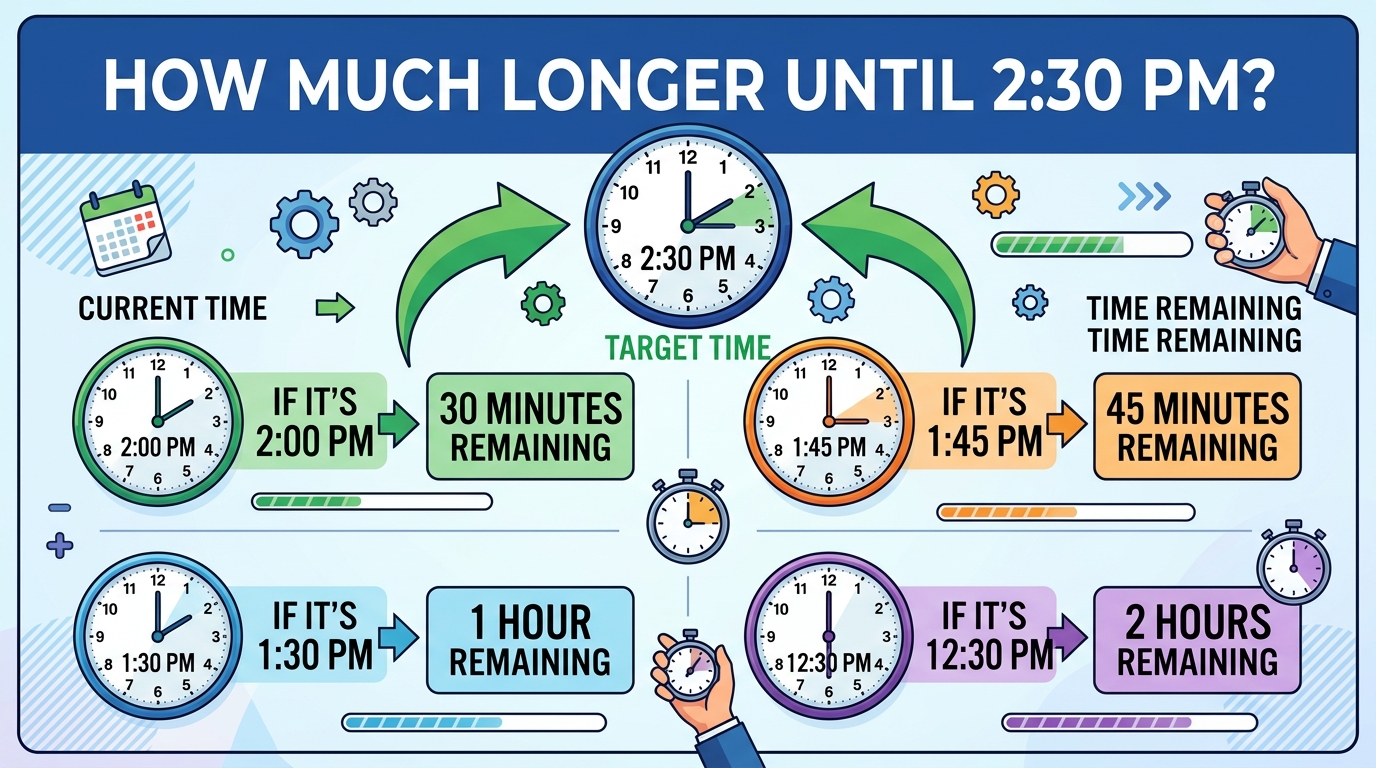

So you’re wondering how much longer until 2:30 pm. It happens to everyone. You glance at the clock, then glance again a few minutes later. That’s just how waiting works. How much longer until 2:30 pm depends on the exact time right now. At 1:00 pm, it’s an hour and a half away. At 2:15 pm, it’s just fifteen minutes. Simple as that.
Knowing how much longer until 2:30 pm helps you plan your day better. Maybe you’re waiting for a meeting. Maybe it’s lunch, or a call, or just the end of a long shift. Either way, how much longer until 2:30 pm is easy to figure out. Just check the time now, then count forward. A countdown timer makes it even easier.
Understanding How Long Until 2:30 PM
When you ask how long until 2:30 PM, you want one simple thing: the exact gap between right now and that target time. It sounds basic, but the answer shifts every minute. If it’s 9:00 AM, you’ve got five and a half hours to go. If it’s 2:15 PM, you’re down to fifteen minutes. The clock never stops, so neither does this number.
Most people don’t sit there doing math in their heads. They pull up a countdown tool instead. It saves time and cuts out silly mistakes. Whether you’re timing a meeting, a break, or just killing time before lunch, knowing the countdown keeps you on track. It’s a small habit, but it works.
How Long Until 2:30 PM Changes Every Second
Here’s the thing nobody thinks about: the countdown never actually holds still. At 1:59:45 PM, you’ve got thirty minutes and fifteen seconds left. Blink, and it’s fourteen seconds. That tiny drop happens every single second, all day long. It’s not a glitch. It’s just how time works.
This is exactly why live countdown timers exist. They refresh constantly, so you always see the real number, not a stale one from a minute ago. Try watching a countdown clock during a busy afternoon. You’ll notice how oddly satisfying it feels to watch those seconds tick away, especially right before something important starts.
Ways to Calculate the Time Until 2:30 PM
You’ve got a few options here, and none of them are complicated. You can do the math yourself, use an online calculator, or grab a duration tool built for exactly this. Each one gets you the same answer. It just depends on how much effort you feel like putting in.
Manual math works fine for quick checks. Calculators and countdown tools work better when you need precision, especially down to the second. Busy people usually skip the mental math and let a tool handle it instead. Less room for error, and honestly, it’s just faster.
Manual calculation
This one’s old school, but it still works. Look at the current time, then subtract it from 2:30 PM. Say it’s 11:45 AM. Subtract that from 2:30 PM, and you land on two hours and forty-five minutes. Not bad for basic subtraction.
Where it gets messy is seconds. Once you start factoring those in, mental math slows down fast. Most people are fine rounding to the nearest minute for everyday use. But if you need exact precision, manual calculation starts to feel more like a chore than a quick glance at the clock.
Learn more:How Long Until 11:00 PM? – Instant Time Countdown Calculator
Using a Countdown Calculator
A countdown calculator does the heavy lifting for you. Type in your target time, and it spits out the exact hours, minutes, and seconds left. No guesswork, no subtraction, no room for mistakes. It just works instantly.
These tools usually update in real time too, so the number you see stays accurate the whole time you’re watching. Many even support different time zones, which comes in handy for remote meetings. It’s a small tool, but it removes a surprising amount of daily hassle.
Using a Duration Calculator
A duration calculator goes one step further. Instead of just comparing now to 2:30 PM, it lets you compare any two moments in time. Think two different dates, or two different times entirely, even across weeks apart.
This comes in handy for project planning or scheduling events way ahead of time. Say you’re mapping out a deadline for next month. A duration calculator handles that math instantly, no sticky notes required. It’s a simple upgrade from a basic countdown, built for bigger planning needs.
Understanding 2:30 PM in Different Time Formats
Not evNot every clock reads the same way. Depending on where you are or what system you’re using, 2:30 PM shows up differently. Here’s a quick breakdown:
| Format | Time |
| 12-Hour Clock | 2:30 PM |
| 24-Hour Time | 14:30 |
| Military Time | 1430 |
So yes, 2:30 PM and 14:30 are the exact same moment. And 1430 in military time means 2:30 PM too. No hidden trick there, just three ways of writing the same thing. Once you know the pattern, converting between formats becomes second nature pretty quickly.
Comparing 2:30 PM with Nearby Times
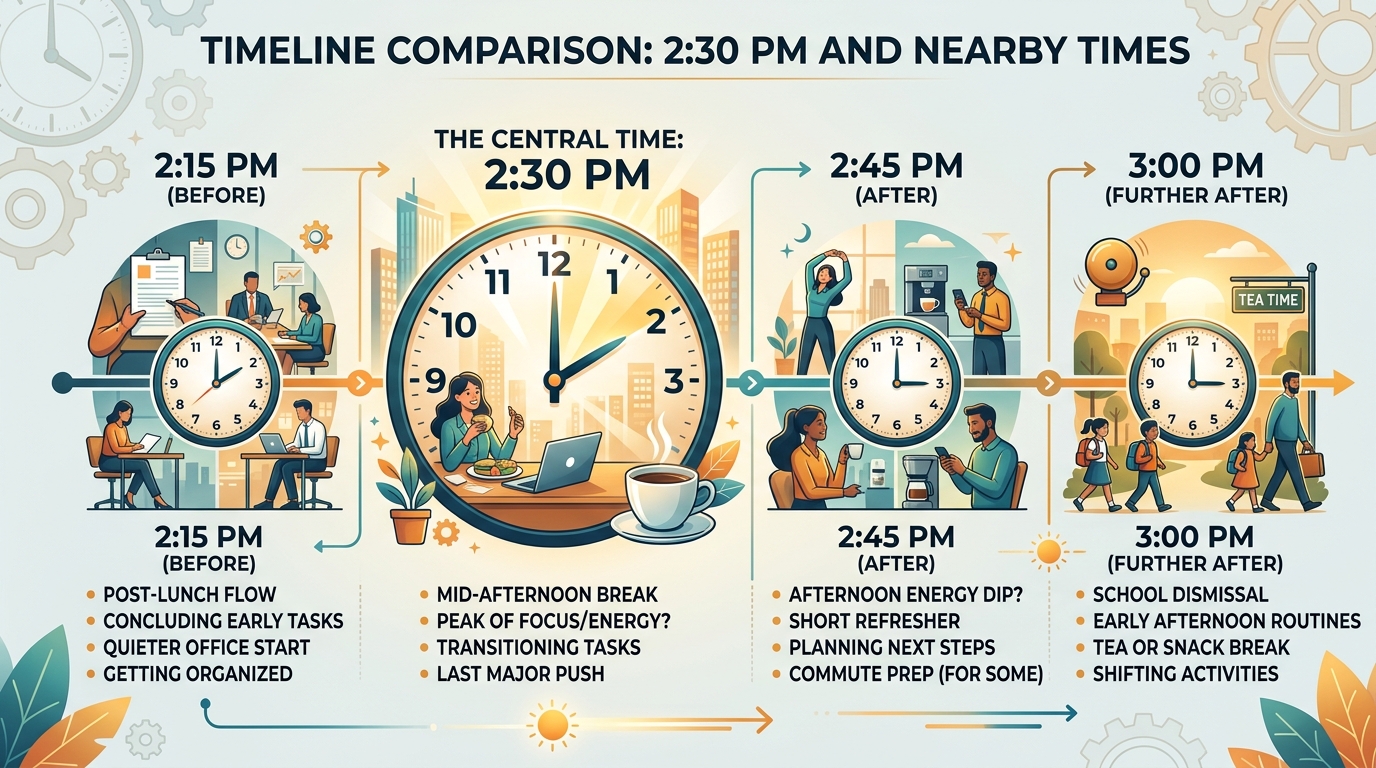
Sometimes 2:30 PM isn’t your exact target. Maybe your meeting starts at 2:15 PM, or wraps up closer to 3:00 PM. Comparing nearby times helps you plan around the actual moment, not just the round number everyone defaults to.
Here are a few common reference points people check alongside 2:30 PM: 2:00 PM, 2:15 PM, 2:25 PM, 2:45 PM, and 3:00 PM. Glancing at these nearby times helps with travel estimates, meeting buffers, and daily scheduling. It’s a small habit that saves you from that last-minute scramble.
Using a Live Countdown for Better Planning
A live countdown isn’t just a number sitting on your screen. It updates every second, showing you hours, minutes, and seconds all at once. That constant motion makes it way easier to gauge exactly how much time you’ve actually got left.
People use live countdowns for all kinds of things: meetings, workouts, cooking timers, exams, even streaming events. Some folks even keep one open all day next to their work. It sounds a little intense, sure, but it keeps deadlines front and center instead of sneaking up out of nowhere.
Time Zones Matter More Than People Think
Here’s something people forget until it bites them: 2:30 PM isn’t the same moment everywhere. Your 2:30 PM in New York looks completely different on a clock in London or Sydney. Same number, totally different moment in time.
This matters a lot for remote meetings, online classes, or international calls. Get the time zone wrong, and you’ll show up an hour early, or worse, an hour late. Double-checking time zones before scheduling anything across regions saves you from that awkward “sorry, wrong time” message.
Daylight Saving Time Can Change Everything
Daylight Saving Time throws a wrench into countdowns that don’t account for it. Places like New York and London shift their clocks forward or back during certain months. If your countdown tool ignores that shift, the number it shows you could be flat-out wrong.
Good countdown tools adjust for this automatically. They track regional DST rules behind the scenes, so you don’t have to think about it. Still, it’s worth double-checking around March and November, since that’s usually when these clock shifts tend to happen.
Popular Tools That Help Track the Countdown
There’s no shortage of tools built for this exact purpose. Countdown timers, scheduling apps, and online clocks all do slightly different jobs, but they share one goal: keeping you on time without the guesswork.
Some popular options include countdown widgets, timer apps, and deadline trackers built into productivity software. Many sync with internet time automatically, which keeps everything accurate across devices. Picking the right one really just comes down to what you’re using it for, whether that’s a quick timer or full schedule tracking.
Productivity Benefits of Knowing the Exact Countdown
Knowing exactly how much time you’ve got left changes how you work. Instead of guessing, you can prioritize tasks based on real numbers. That shift alone cuts down on wasted time and last-minute panic before deadlines.
Say you’ve got a meeting at 2:30 PM and a report due beforehand. A clear countdown helps you decide what gets done first. Plenty of productivity experts actually suggest working backward from deadlines instead of just watching the clock crawl forward. It’s a small mindset shift with a real payoff.
Morning vs Afternoon Countdowns
Waiting for something in the morning feels different than waiting in the afternoon. Morning countdowns usually revolve around breakfast, emails, or getting out the door on time. There’s a certain rush to it, a fresh-start kind of energy.
Afternoon countdowns lean toward lunch breaks, meetings, or wrapping up tasks before deadlines hit. By evening, most people start shifting focus toward tomorrow’s plans instead. It’s a pattern that repeats daily, quietly shaping how we structure our time without most of us even noticing it.
Choosing the Right Countdown Tool
Not all countdown tools are built the same. Some update in real time down to the second. Others lag or round awkwardly, which isn’t great when precision actually matters for your schedule.
Look for tools with automatic refresh, time zone support, and clear digital displays. Bonus points if it syncs with internet time to avoid drift between devices. A reliable countdown tool might seem like a small thing, but it makes a real difference when you’re racing against an actual deadline.
FAQ’S
How many hours until 2:30 pm?
How much longer until 2:30 pm depends on the time right now. Just subtract your current hour from 2:30 pm to get the answer.
How many minutes until 2:30 pm?
How much longer until 2:30 pm in minutes changes fast, sometimes every second. Subtract your current time from 2:30 pm, including any leftover minutes.
What time is left until 2:30 pm?
How much longer until 2:30 pm shows up clearly on a live countdown tool. It updates instantly, so you always see the correct time left.
How much longer until 2:30 pm?
How much longer until 2:30 pm keeps shrinking every second that passes. The exact number depends entirely on your current local time.
Is 2:30 pm the same as 14:30?
Yes, 2:30 pm and 14:30 mean the exact same moment. So how much longer until 2:30 pm equals how much longer until 14:30 too.
Conclusion
So, how much longer until 2:30 pm. It really just comes down to one thing: your current time right now. That’s the whole answer. How much longer until 2:30 pm changes every second, and that’s completely normal. It’s not a glitch, it’s just how clocks work. Whether you’re waiting on a meeting, a lunch break, or the end of your shift, this simple question comes up more than you’d think.
The good news is you don’t need to do hard math anymore. A quick countdown tool tells you how much longer until 2:30 pm in seconds flat. No guessing, no stress, just a clear number. Next time you catch yourself glancing at the clock, remember, figuring out how much longer until 2:30 pm takes just a few seconds. Simple question, simple answer, and now you know exactly how to find it.
